
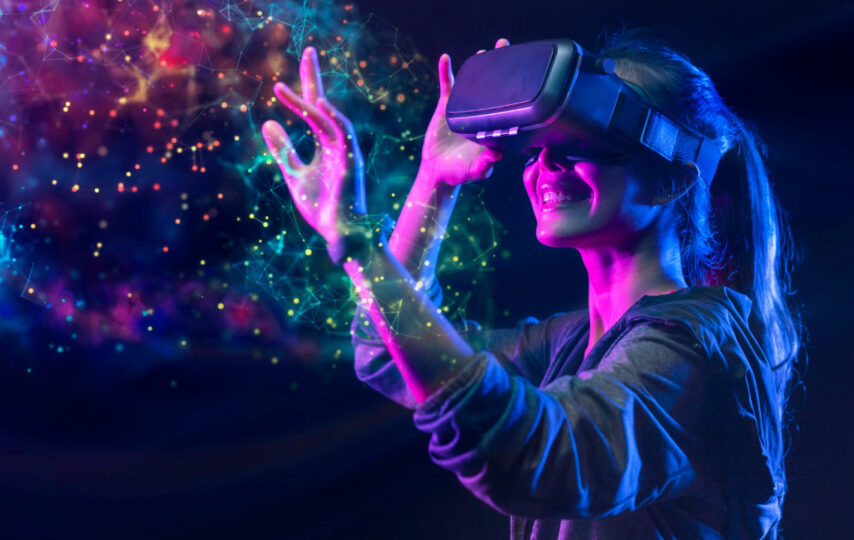

The use of virtual reality in education is speedily reforming the learning experience for students by merging technology with traditional academics. VR creates an immersive and interactive environment that changes how students understand and retain information.
In a way that textbooks cannot match, VR permits students to imagine ideas, engage with virtual objects, and also participate in the simulated environment in all things from science labs to history classes. In this blog, we are going to explore ten strong arguments for why this emerging technology is revolutionizing the future of education.
Benefits of Virtual Reality in Education for Students Are:
1. Immersive Learning Experience
Instead of absorbing concepts or passively learning, VR allows students to actively participate in a given lesson. In addition to reading or listening, students can immerse themselves in the subject matter, walking on the surface of Mars or inspecting human anatomy in 3D grabs the interest of the students and stokes their curiosity.
2. Real-Life Application in Schools
Virtual reality for schools is no longer a futuristic thought. Many institutes eagerly use VR for teaching science, history, geography, and even soft skills. Students conduct chemical experiments, visit virtual museums, or undergo job training simulations in a safe environment. By this means, the student not only learns more but is also more engaged. Some virtual reality setups are already taking over as much space as the old projectors used to in the classrooms.
3. Rise of Educational Apps for All Levels
Virtual reality has become the most demanded technology in the modern era, all credit goes to virtual reality education apps. These applications offer interesting exercises, quizzes, and personalized lessons for students at every educational level, from primary school to college and university. Through platforms like ClassVR Engage and VictoryXR, teachers can support their students as they commence on an immersive educational journey. Such apps enable students to conceptualize tricky ideas, but teaching does not get any easier with enjoyment now.
4. Emphasising the Importance of VR in Education
Virtual reality’s ability to transform complex concepts into immersive experiences is what makes the importance of VR in education. Through the creation of interactive visual and hands-on learning environments, all of which are frequently lacking in traditional educational institutions, VR aids in student engagement, deeper understanding, and simulation of actual-world problems.
5. Safe Simulation of Practical Scenarios
One of the major benefits of VR is that it permits students to mimic costly or dangerous activities without real-world consequences. In a safe and repeatable environment, the learners can gain experience if they are piloting an aeroplane, doing any surgery, or dealing with any emergency.
6. Personalised and Adaptive Learning
Instead of detaching students, VR (Virtual Reality) promotes new connections between the students. The students coming from different geographical places can work together as a team on the projects, carry out group experiments, or also can do discussions with the help of shared virtual spaces. These settings assist both verbal and nonverbal communication and look like an actual classroom.
7. Fosters Global Exposure
Students can learn many things about foreign cultures, ecosystems, and histories without leaving their school or college classroom; all credit goes to virtual reality. They can also experience various travel destinations, such as China or the Amazon Rainforest, which are made better when associated with courses like geography and history.
8. Improved Collaboration and Social Interaction
The students never feel isolated or stuck in one space only due to Virtual Reality settings. VR helps them in collaborating and also makes it possible to work together on the project, carry out group experiments, and also participate in debates through shared vr environments. Simulating the real classroom setting helps in making smoother verbal and nonverbal communication.
9. Bridges the Skill Gap for Future Careers
Today’s students are refashioned to meet the demands of tomorrow’s jobs. Those training with VR are gaining skills in 3D modelling, virtual presentations, and technical simulations that are getting more and more important in engineering, healthcare, design, and even space science. Integrating VR with day-to-day learning makes educators create opportunities wherein contemporary students are preparing for the digital world.
10. Boosts Motivation and Reduces Dropout Rates
Making learning fun and interesting automatically motivates the learners. Flying the flag of gamified learning, VR promotes rewarding progress, challenges, and a sense of achievement that spurs the learners. This method helps in reducing boredom and academic stress.
Applications of Virtual Reality in Education
1. Science and Biology: Students can explore biology subject models through safe, interesting virtual lab experiences.
2. History and Geography: Learners visit historical places virtually, enhancing cultural understanding deeply.
3. Medical Training: Simulated surgeries help students practice skills in realistic medical scenarios.
4. Engineering and Architecture: Design concepts come alive as students walk through their models.
5. Arts and Design: Digital 3D art is produced by students and displayed virtually all over the world.
6. Special Education: Virtual Reality in Education helps everyone learn in a personalised, inclusive way.
How is Virtual Reality Integrated into Education?
With the help of simulation labs, interactive virtual classrooms, and 360-degree content experiences, VR is upgrading education as a teaching strategy. In an immersive virtual environment, Safe practice spaces are provided to the students where decision-making, problem-solving, and task repetition take place while they are protected from the consequences of failure. This VR technology allows the student to perform a science experiment virtually, conduct surgery, or travel through places, and also offers hands-on training that fosters critical thinking and confidence, in making steps. When merged with the traditional methods, advanced tech enables teachers to make learning more interesting, more effective, and more relevant for the modern era.
Why is Virtual Reality the Future of Education?
The reason is that virtual Reality in Education eliminates traditional classroom boundaries to open up global interlaced experiences far more extensive than books or screens. VR abets students in looking into different cultures, historic events, and environments so deeply that inter-perspective learning provides cultural exposition and invites curiosity about the world. VR edifies cross-border educational processes by facilitating intercontinental cooperation, virtual exchange programs, and shared classroom activities beyond geographical limitations. By making education more intimate and engaging, VR is setting a new precedent for the unfolding developments of education in the days to come.
Final Thoughts
The installation of Virtual Reality in Education is more of an earthy change in the conception of how students learn, grow, and succeed. From immersive experiences to personalized lessons, VR is carving out an inclusive, engaging environment for education, and one that meets the requirements of the new world. The more schools that acquire virtual reality equipment, consult virtual reality education apps and recognize the significance of VR in education, the closer we get to a world that renounces walls and restrictions from traditional schools.