
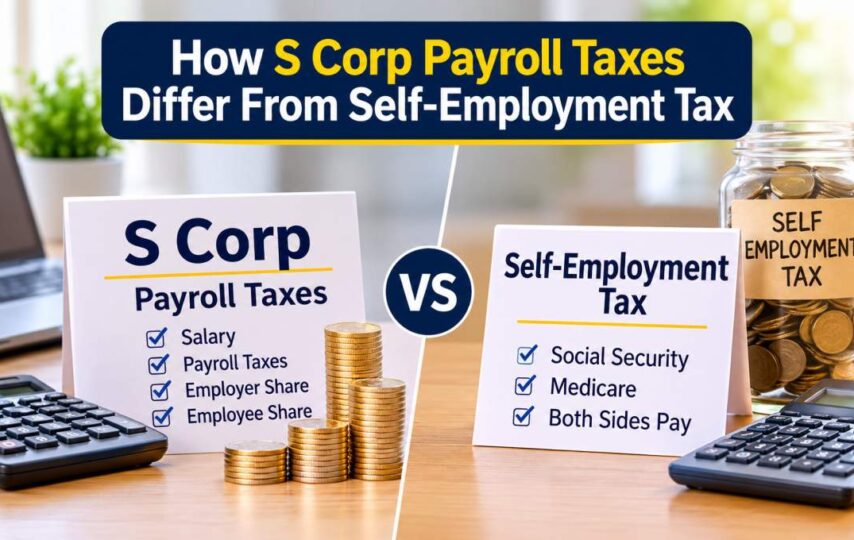

If you’re thinking about electing S corp status, you’ve probably heard that it can lower your taxes. The savings come from a key difference in how your income is taxed: self-employment tax on all your profit versus payroll taxes on only part of it. Here’s how each one works.
What self-employment tax covers
When you work for an employer, Social Security and Medicare taxes are split. You pay half through paycheck withholding, and your employer pays the other half. When you’re self-employed, you’re both the employee and the employer, so you pay both halves yourself. That’s self-employment tax.
The total rate is 15.3 percent. Of that, 12.4 percent goes to Social Security and 2.9 percent goes to Medicare. The Social Security portion applies only up to an annual wage base, which is $184,500 for 2026. The Medicare portion has no cap, and higher earners pay an extra 0.9 percent above certain income levels.
For sole proprietors and single-member LLCs, self-employment tax applies to nearly all of your net profit. If your business earns $120,000 after expenses, most of that amount is subject to the full 15.3 percent. You can deduct half of your self-employment tax when calculating your income tax, but it’s still one of the biggest bills freelancers face.
This tax is separate from income tax. Many new freelancers are surprised to learn they owe both, which is why setting money aside from every payment matters so much. A self-employed accountant can help you estimate both and plan quarterly payments around them.
How payroll taxes apply to an owner’s salary
When your business elects S corp status, the math changes. You become an employee of your company and receive a salary through payroll. Your company withholds your share of Social Security and Medicare from your paycheck and pays the matching employer share. Together, those S corp payroll taxes add up to the same 15.3 percent.
The difference is what they apply to. Payroll taxes only apply to your salary, not to your entire profit. Any profit left after your salary and business expenses can be paid to you as a distribution, and distributions aren’t subject to Social Security or Medicare taxes.
Here’s a simple example. Say your business earns $120,000 in profit and you pay yourself a $70,000 salary. Payroll taxes apply to the $70,000. The remaining $50,000 can be taken as a distribution without that 15.3 percent tax, which could save you several thousand dollars. You still pay income tax on the full amount.
There’s a catch, though. The IRS requires S corp owners to pay themselves a reasonable salary for the work they do. Setting it artificially low to avoid payroll taxes can lead to audits, back taxes and penalties. S corps also come with added costs, including payroll software, a separate business return and sometimes state fees.
Understanding the difference between these two taxes is the first step in deciding whether an S corp makes sense for you. Collective helps solopreneurs compare the numbers, set a reasonable salary and run payroll, so the savings you expect actually show up.