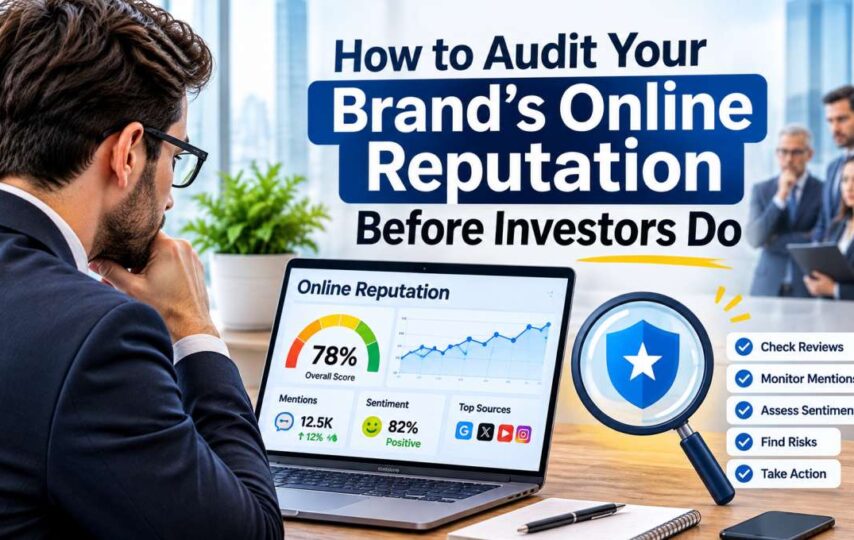

Have you ever Googled your own brand name to see what comes up? If not, you can do it now. This will help you know what a potential investor might find when they search for your business.
You must remember that investors don’t just look at profits, business plans, and growth figures anymore. They also want to know whether people trust your brand.
A few negative reviews, outdated company details, or misleading information online can damage your prestige.
And most businesses discover these issues only when someone points them out. This is why they often seek online reputation management (ORM) services from professionals.
Let’s understand how you can audit your online reputation before investors do.
What Does Auditing a Brand’s Online Reputation Even Mean?
We’ll begin our guide by understanding what auditing a brand’s online reputation actually means.
An online reputation audit is basically a detailed review of how people see your brand across the internet.
It allows you to check not only search results and customer reviews but also social media conversations, news coverage, business listings, and other public information connected to your company.
You can also seek a reputation management service. These experts not only protect and monitor but also influence public perception across digital platforms, customer reviews, and social media.
Apart from that, you may not know this, but online reputation management in Dubai is pretty common. It helps businesses review their strategy.
How Can You Audit Your Brand’s Online Reputation Before Investors Do?
Now comes the main part that is auditing the online reputation of your brand.
To do so, you must begin by searching for your brand name as an investor and reviewing customer feedback as well as public complaints.
Besides that, you have to not only check your business information and evaluate your Wikipedia presence but also monitor news coverage and social media discussions.
Lastly, you should create a risk report and fix the biggest problems first.
1. Search Your Brand Name as an Investor
First of all, you must start with a simple Google search. Enter your company name and examine the first few pages of results.
And you have to repeat this process using variations such as your brand name with words like reviews, complaints, leadership, scam, and news.
Besides that, you should search not only for your founders and executives but also for other public-facing leaders. This is because many investors often investigate the people behind a company alongside the business itself.
You need to pay attention to what appears first. You can simply record your findings in a spreadsheet.
2. Review Customer Feedback and Public Complaints
Customer reviews are actually quite important. They can reveal patterns that are easy to miss when you focus only on your website and marketing materials.
You can check relevant review platforms and social media channels. You should look not only for repeated complaints and unanswered questions but also for concerns that appear across multiple sources.
You must never panic over one negative comment. Remember that a single complaint doesn’t define your brand. But yes, several similar complaints may point to a genuine issue that needs attention.
However, you must never panic over one negative comment. Remember that a single complaint doesn’t define your brand. But yes, several similar complaints may point to a genuine issue that needs attention.
But make sure that you respond professionally and offer practical solutions wherever possible.
And you should never fake reviews or pressure customers to remove honest criticism. This can damage trust instead of restoring it.
You can also consider seeking a reliable reputation management service. It can help you not only monitor feedback and identify recurring issues but also develop responsible responses.
3. Check Your Website and Business Information
Your website is often one of the first places investors visit after searching for your company. Hence, you need to ensure that it presents a clear and consistent picture of your business.
Ensure that not only your business details and legal entity status but also your operational status are identical across your website, social channels, and business directories.
If your business operates internationally, you have to review its information in every important market.
Also, accurate Arabic and English content is especially useful if your company communicates with investors across the UAE and other multilingual regions.
Many businesses often seek assistance with Wikipedia page translation Arabic English to ensure accuracy.
4. Monitor News Coverage and Social Media Discussions
Besides that, your reputation can change quickly when a news story, customer complaint, or public discussion gains attention.
You must search for recent coverage of your company and review public conversations on relevant social platforms. This will allow you to see how your brand is being mentioned.
However, you need to look beyond the number of mentions. You should consider who is discussing your company, what they are saying, and whether the information is supported by evidence.
You can also seek online reputation management (ORM) services for ongoing monitoring. These professionals can help you track not only brand mentions and review trends but also emerging concerns.
5. Evaluate Your Wikipedia and Knowledge Panel Presence
You may not know this, but investors often look for information beyond a company’s own website. They can use public knowledge resources, such as Wikipedia, for research.
You should verify whether an existing Wikipedia article accurately represents your company. Apart from that, you should look not only for outdated facts and unsupported statements but also for missing context and references that no longer work.
Remember that not every company qualifies for a Wikipedia article. You can also seek a Wikipedia page. These experts provide assistance with research, source evaluation, and drafting.
However, you must keep in mind that no service can guarantee that an article will be accepted or remain published. Wikipedia has strict rules on neutrality, reliable sourcing, and paid contributions.
For businesses serving multilingual audiences, seeking help with Wikipedia page translation Arabic English can also be pretty helpful for reviewing language consistency.
6. Create a Risk Report and Fix the Biggest Problems First
Last but not least, you have to organise your findings in order of importance. This is because not every issue deserves the same level of attention.
You can use a simple priority system
- High priority
You first have to prioritise not only false allegations and serious unresolved complaints but also inaccurate leadership information and misleading claims that could affect investor confidence.
- Medium priority
After dealing with major issues, you have to take care of outdated business listings, unanswered customer feedback, and incomplete company profiles.
- Low priority
Finally, you can focus on minor formatting issues or older content that has little effect on your current reputation.
Readers Frequently Ask
What is meant by auditing a brand’s online reputation?
Ans. Auditing a brand’s online reputation is the process of systematically searching, analysing, and rating how a business is perceived across digital channels. This includes not only search engines and AI assistants but also social media, review platforms, and news outlets.
How often should a business actually audit its online reputation?
Ans. Businesses should audit their online reputation at least once every quarter (every 3 months. However, a monthly review can also be a useful starting point for many new businesses.
How can you audit the online reputation of your brand?
Ans. To audit the online reputation of your brand, you have to not only search for your brand name as an investor and review customer feedback but also check your business information and evaluate your Wikipedia presence. You must also monitor news coverage and social media discussions. Also, create a risk report and fix the biggest problems first.
Wrap Up!
Your brand’s online reputation can shape the first impression you make on potential investors.
You need to take the time to understand what the investors are likely to find before they research your company.
You should not only search for your brand name as an investor and review customer feedback but also check your business information and evaluate your Wikipedia presence.
In addition to this, you have to monitor news coverage and social media discussions. You also need to create a risk report and fix the biggest problems first.
However, you can also seek a trustworthy reputation management service. These experts will make reputation management easier for you.