
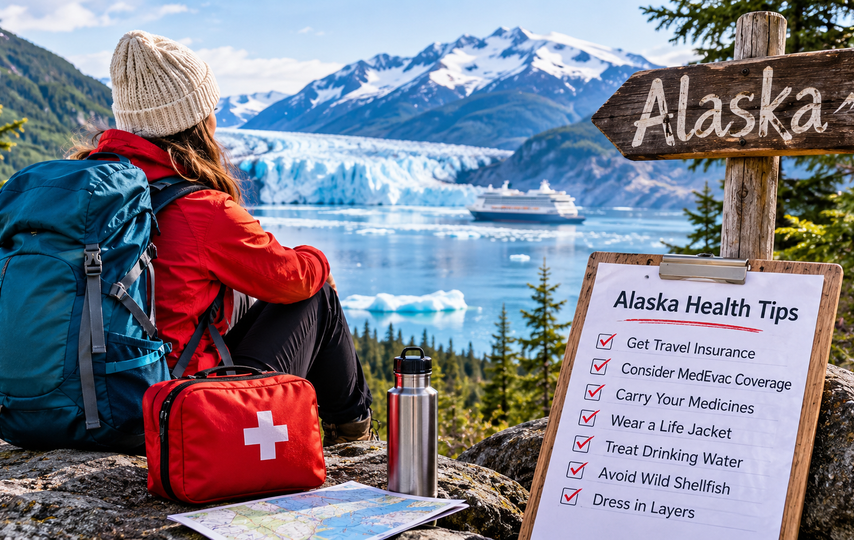

Traveling to Alaska is safe for most visitors, and 12 habits cover nearly all of the health risks. The four that matter most are insurance that pays for air evacuation, a life jacket on every boat, treated drinking water and no wild shellfish. The rest deal with smaller problems that can still wreck a day. Many popular stops, from Denali to the Inside Passage, sit far from a hospital, so a minor problem costs more here than it does at home.
This guide is general information, not medical advice for your situation. If you have a heart, lung or allergy condition, ask your own clinician before you go.
1. Does your health insurance work when traveling to Alaska?
For U.S. residents, usually yes. Alaska is a state, so domestic plans normally cover care there. Call your insurer anyway and ask whether urgent care clinics along your route are in network.
Cruise passengers need one more check. Alaska itineraries often stop in Canada, and Medicare generally doesn’t pay for care outside the U.S. and its territories, according to a cruise insurance broker. International visitors should arrange U.S. health coverage before they fly, since American medical bills are not small.
2. Do you need medical evacuation coverage?
Yes, if your trip leaves the road system or includes a small plane, a ferry, a remote lodge or a glacier hike. Of everything on this list, this is the one purchase worth refusing to skip.
Much of the state has no road to a hospital, so a broken leg or appendicitis often means a flight. Alaska Collection, a travel company, says medevac can cost tens of thousands of dollars. One insurer quotes $100,000 to $250,000 for cruise evacuations, but companies that sell policies have a reason to quote high, so read that as a ceiling. Check that the policy names air ambulance and covers your activities, such as flightseeing.
3. What if you get sick far from a clinic?
For minor problems like a sinus infection, a rash, a UTI or a medication question, a video visit can save you a day. Telemedicine Alaska runs same-day virtual urgent care, and its site says travelers can use it while they are physically in Alaska.
There are limits. Prescriptions must be picked up at an Alaska pharmacy, and some conditions need an in-person exam. Chest pain, trouble breathing, a head injury or heavy bleeding means 911 or the nearest emergency room, not a video call. Save the clinic’s contact details before you leave home, because signals can vanish outside towns.
4. What should go in your medication kit?
Bring every prescription in its original bottle, plus extra days. Weather grounds small planes and delays boats in remote areas, so a three day trip can turn into five.
Keep medicines in your carry-on, with a written list of names and doses in case you need a refill. Add the basics: blister care, an antihistamine, something for diarrhea and a pain reliever. Anyone allergic to bee stings should carry their medication in the backcountry, Alaska’s Department of Natural Resources advises, and bee numbers can run high after a heavy-snow winter.
5. Why is cold water the biggest danger on a boat?
It can disable you within minutes, before hypothermia starts. Wear a life jacket on every skiff, kayak and fishing charter, even when the day feels warm.
Alaska’s Department of Natural Resources says most boating deaths in the state come from drowning in cold water. Within three minutes of falling in, you gasp and hyperventilate. Within about 30 minutes your arms and legs stop working properly, whatever your swimming skill. Boating magazine reports that water pulls heat from the body 25 times faster than air. Without flotation, most victims die long before hypothermia sets in.
6. How do you avoid hypothermia in July?
Dress in layers, keep them dry, and leave the cotton at home. The Alaska Department of Labor notes that hypothermia can happen above freezing, and cold, wet, windy weather is the usual cause.
Cotton holds water and pulls heat from your body, which is why a Coast Guard boating safety analyst called it one of the worst fabrics for cold, damp days. Wear wool or synthetic next to the skin, add a warm middle layer, and carry a waterproof shell. A two hour glacier cruise on an open deck can chill you through in the middle of summer.
Know the warning signs: confusion, clumsiness, slurred speech and shivering you can’t control. Hypothermia clouds judgment, so the person affected is the last to notice. Watch your hiking partner, not only yourself.
7. Is stream water in Alaska safe to drink?
Treat it before you drink it. Giardia comes from the droppings of beavers, muskrats, moose and caribou, and clear mountain water can still carry it.
CDC data, as reported by the Anchorage Daily News, puts Alaska among the states with the most giardia infections. The National Park Service calls a rolling boil for one minute the most certain fix, plus one extra minute for every 1,000 feet of elevation, and ranks portable filters and disinfectants below it. Alaska.org argues the danger is often overstated, and I agree it’s smaller than the rumors. Still, avoid water near beaver dams or heavy animal traffic.
The timing catches people out. Symptoms such as fever, fatigue and diarrhea can take about two weeks to appear, according to a University of Alaska Fairbanks science column, so you may be home when it hits. Tell your doctor you drank backcountry water.
8. Can you eat shellfish you dig up on an Alaska beach?
Leave wild shellfish alone. State environmental health officials say no Alaska beach is certified safe, and recreational harvests are not tested for paralytic shellfish poisoning (PSP).
Cooking does not destroy the toxin, and neither does freezing. Early symptoms are tingling in the lips and fingertips, then numb limbs and trouble breathing. A 2020 death in Unalaska was the state’s first PSP fatality since 2010, and KTOO reported high toxin levels around Southeast Alaska again in June 2026. Restaurant shellfish is a different matter, since commercial harvests are tested. Order the clams at dinner and leave the beach ones alone.
9. Are Alaska mosquitoes as bad as people say?
It depends on where you stand and what month it is. Alaska.org says visitors only face real trouble from the second week of June to the last week of July, and the cities, parts of the Kenai Peninsula and breezy spots above treeline stay fairly clear.
Denali and wet tundra are the exceptions. Pack repellent with 15 to 30 percent DEET, as Alaska Travel recommends, and take a head net for backcountry days. Long sleeves work better than any spray.
10. How do you sleep under the midnight sun?
Bring a snug blackout eye mask and ask your hotel for blackout curtains. For a short trip, an ADN piece quoting an Alaska Sleep Clinic writer suggests keeping your sleep schedule close to your home time zone.
Practice with the mask before you leave, because a mask you’ve never worn is a bad thing to test at 1 a.m. under a bright sky. Even locals struggle. In a 2024 Sleepopolis survey of 201 Alaskans, about 46 percent used blackout curtains. That’s a mattress company’s small sample, so treat it as color, not science.
11. Does altitude matter on an Alaska trip?
For most visitors, no. Climbers on Denali are the exception. The National Park Service says 14,000 feet in Alaska feels like 16,000 to 17,000 feet at lower latitudes, because the air holds less oxygen this far north.
Park guidance suggests sleeping no more than about 1,600 feet higher each day, with a rest day every three or four days. A climber with severe symptoms should go down until they clear, according to Denali rangers.
12. What should you do before a hike where no one will find you quickly?
Tell someone your route and return time, and carry a satellite messenger. Denali’s rangers have received distress alerts through Garmin inReach devices.
Phone coverage thins out fast away from towns, so leave your plan with your lodge or a friend and agree on a time when they should call for help. Turn around when the weather turns. Wet and wind is how a pleasant hike becomes a hypothermia case (see tip 6).
FAQs
Do Alaska mosquitoes carry disease?
Not to a meaningful degree. A travel guide from Expeditions explains that the summer is too short for the parasites or the mosquitoes to complete their life cycles and pass on illness.
Is there poison ivy in Alaska?
No. The state has no poison ivy or oak, but it does have cow parsnip, which can irritate skin. Learn what it looks like before you wade through tall plants.
Should I get a flu shot before traveling to Alaska?
It’s a sensible step. In early 2020, with coronavirus in the news, Alaska’s chief epidemiologist pointed out that influenza makes many more people sick each year. Airports and ships put a lot of strangers in close quarters.
Can I use my phone for emergencies in the backcountry?
Don’t count on it. Coverage thins out away from towns, which is why a satellite messenger and a shared plan matter.
Before you book
Call your insurer and ask two things: does the policy pay for air ambulance, and does it cover the activities you booked? Do that before you pay for any non-refundable tours. With evacuation coverage and a life jacket sorted, traveling to Alaska gets far simpler, and the rest of this list is mostly a packing job.