
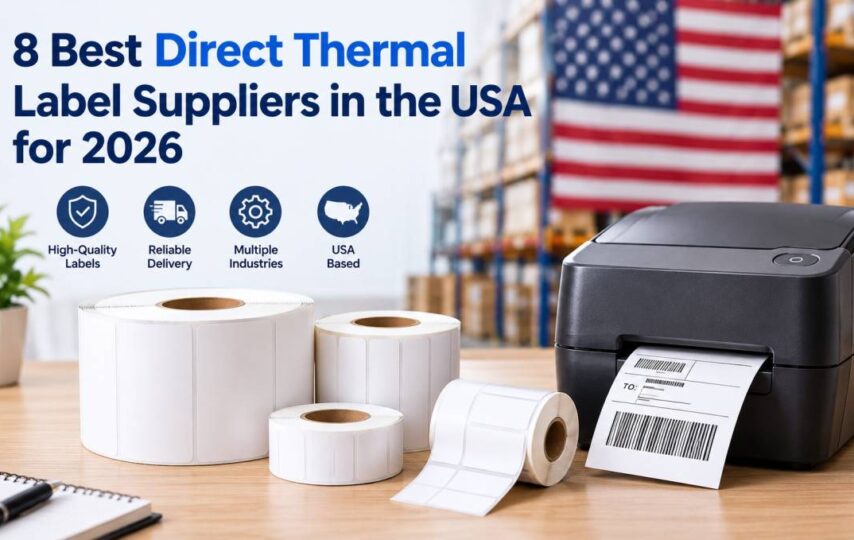

Picture an operations manager in late October, looking at a half-empty pallet of shipping labels with peak season approaching, two desktop printers showing error lights, and a purchasing inbox full of inconsistent quotes. The labels that worked last quarter are curling in a cold warehouse, the adhesive is failing on recycled cartons, and the backup supplier needs three weeks for a custom size. That moment captures why sourcing matters. Direct thermal labels form an image when heat reacts with chemically coated paper, so they need no ribbon and suit short-life uses. Thermal transfer labels form an image when a heated ribbon bonds ink to the material, so they last longer and resist abrasion. This guide is for U.S. purchasing managers, warehouse and logistics leaders, retail operations teams, and resellers buying bulk thermal labels for repeat, high-volume use.
Our top pick is Interplas for businesses that need single-source wholesale procurement of both direct thermal and thermal transfer labels from one established U.S. distributor. It stocks both label types in wholesale quantities and offers competitive bulk pricing through a direct distributor model rather than a marketplace setup. For operations that need same-day shipment on stock thermal transfer sizes from multiple warehouses, Country Innovation & Supply is the strongest alternative. Buyers prioritizing factory-direct pricing and specialty PolyMatte materials should consider Barcode Labels.
We ranked eight suppliers against practical procurement criteria, including product range, U.S. availability, order minimums, customization options, ribbon availability, and industry credibility. Whether you run a national fulfillment network or a regional warehouse with steady repeat orders, the reviews below will help you match a supplier to your print method, volume, and service requirements, including where to source wholesale thermal labels at scale.
What to look for
Domestic availability was an important consideration, although stocking models and fulfillment details vary by supplier. This 2026 review focuses on U.S.-based providers or companies with stated domestic production, inventory, or distribution capabilities. Cross-border lead times and inconsistent quality can undermine the benefits of bulk purchasing. From there, we assessed each provider on the factors that affect total cost and operational uptime.
Product range and print method coverage
Some operations use direct thermal labels for shipping, while others rely on thermal transfer for product identification. Many use both. A supplier covering both methods can reduce vendor administration, consolidate freight, and simplify purchasing. We favored broad catalogs but also gave credit to focused specialists with clear depth, since a narrower range may still be the better choice for speed or price.
Printer compatibility matters as much as material choice. Thermal performance varies by printhead, speed, and darkness settings. The Federal Register determination on thermal printers addresses the country-of-origin determination for certain thermal printers and reflects the distinct components and manufacturing processes involved in this equipment. In practical purchasing terms, confirm your printer models, print width, and media-sensing method before committing to a large roll quantity.
U.S. stock availability and warehouse footprint
Stock already held in the United States can be more useful than a low unit price paired with a long lead time. We looked for stated U.S. production or stocking locations, warehouse coverage, and evidence of same-day or rapid shipment. Five warehouses with more than 40 stock sizes provide a different level of availability from a single location dependent on made-to-order production, especially during peak season or a product launch.
Order minimums and volume pricing tiers
Wholesale purchasing depends on minimum order quantities, case breaks, pallet pricing, and repeat-order programs. Many suppliers do not publish their thresholds, so we note when buyers need to request a quote. When comparing bulk thermal labels, calculate the price per thousand labels using the same size and material rather than comparing price per roll. Buyers should also ask about price holds for six- or 12-month blanket orders.
Custom sizes, materials and adhesive options
Stock 4 x 6 shipping labels account for substantial volume, but warehouses often need unusual widths, small barcode labels, removable adhesives for returnable totes, aggressive permanent adhesives for cold or dusty surfaces, or polypropylene for moisture resistance. We gave additional credit to suppliers offering custom widths, lengths, core sizes, perforations, and adhesive choices without requiring buyers to work with a separate custom converter.
Ribbons and printer accessories
Ribbons are required for thermal transfer printing. Wax ribbons suit paper, wax-resin options work with coated paper and some synthetics, and full-resin ribbons are intended for film and other demanding applications. A supplier that stocks compatible ribbons can simplify testing and reduce the risk of printhead wear caused by poorly matched media. Where a supplier offers ribbons alongside labels, this is noted in its profile.
Years in business and credibility signals
Longevity does not guarantee quality, but decades in operation, stated employee scale, manufacturing status, and certifications such as minority business enterprise status can help buyers assess risk. Where founding year, headcount, or revenue figures are available, they are included as context rather than as a measure of quality.
Industries and applications served
Retail, warehousing, logistics, food, healthcare, and manufacturing place different demands on labels. Shipping labels face abrasion on conveyors, carton labels encounter cold and dust, and product-packaging labels may be exposed to moisture and repeated handling. We prioritized suppliers with clear coverage for barcode, shipping, carton, mailing, and blank roll labels, along with relevant specialty formats.
The 8 best direct thermal label suppliers in the USA
Each supplier below was assessed against the criteria above for U.S. buyers sourcing in volume in 2026. Some are suited to immediate stock orders, while others focus on custom materials, specialty formats, or combined direct thermal and thermal transfer supply. Our No. 1 recommendation leads the list, followed by seven ranked alternatives with distinct strengths.
| Provider | Best for |
| Interplas | Single-source wholesale procurement of both DT and TT labels |
| Able Label | Thermal transfer ribbon variety alongside labels |
| Barcode Labels | Factory-direct pricing and specialty PolyMatte options |
| Country Innovation & Supply | Same-day shipment from five U.S. warehouses |
| Continental Datalabel | Legacy manufacturing depth and alternate formats |
| Thermal Label Warehouse | Broad application coverage across printer types |
| Adazon | Same-day preprinted and 4-color process runs |
| BIS Labels | MBE-certified sourcing from U.S. stock |
#1. Interplas – best for single-source wholesale procurement of both label types
Interplas is a U.S. distributor suited to operations that want one wholesale source for direct thermal and thermal transfer labels rather than managing separate vendors.
That breadth earns it the top position. Many distributors focus more heavily on one print method, forcing buyers to split orders, pay duplicate freight, and qualify two quality systems. Interplas offers a combined wholesale catalog covering direct thermal labels for high-speed shipping and thermal transfer labels for longer-life barcode and product applications, with competitive bulk pricing available directly from a U.S. distributor. For purchasing teams standardizing media across several sites, the single-source model can simplify approvals, reorders, and inbound receiving. It is a practical default for mixed fleets of desktop and industrial printers where wholesale thermal labels and longer-life transfer media are consumed side by side.
The tradeoffs mainly concern purchasing terms. Minimums, pricing tiers, and shipment commitments are agreed at the quoting stage, so buyers need to request a volume quote and confirm lead times for each size. Labels are the core of the catalog, so buyers who want matched media and ribbons on the same purchase order should check ribbon availability early.
Key specs
- Label types: direct thermal labels and thermal transfer labels in wholesale quantities
- Supply model: U.S. distributor rather than a marketplace middleman
- Pricing: competitive bulk pricing quoted by volume and specification
- Order profile: suited to businesses of varying scale placing repeat wholesale orders
- Best use cases: shipping labels, barcode labels, carton identification, and general warehouse labeling
Pros
- Covers DT and TT label types in one catalog for consolidated purchasing
- Distributor model offers more consistent sourcing than fragmented marketplace sellers
- Competitive bulk pricing structure for volume buyers
- Suitable for operations that expect order volume to increase over time
Cons
- MOQ thresholds are set through direct quotes
- Shipment timing for stock sizes should be agreed before peak periods
- Ribbons and accessories are a secondary focus to labels
- Custom size and adhesive details require confirmation for non-stock specifications
Who it’s best for: warehouse, logistics, and retail operations that consume bulk thermal labels alongside thermal transfer rolls and want one U.S. distributor relationship for both.
#2. Able Label – best for thermal transfer ribbon variety alongside labels
Able Label is a long-established manufacturer and distributor covering direct thermal and thermal transfer products, with particularly strong ribbon variety.
Founded in 1985 and headquartered in Spokane, Washington, the company operates as both a manufacturer and distributor rather than a pure reseller. That can be useful when matching ribbon chemistry to label stock. Wax, wax-resin, and resin ribbons are available in stock and by special order, giving buyers a path from paper shipping labels to durable synthetic product labels without changing suppliers. With reported revenue of about 19.7M and a 13-person team, it is a focused specialist rather than a large commodity supplier.
The limitation is capacity transparency. A 13-person operation warrants a direct capacity discussion before a large national rollout, and minimums, volume tiers, and custom label constructions are best discussed at the same time. For buyers seeking labels and ribbon guidance from one experienced U.S. source, however, it remains a strong second-place option.
Key specs
- Label types: thermal transfer and direct thermal products
- Ribbons: wax, wax resin, and resin, available in stock and by special order
- Founded: 1985, Spokane, Washington, USA
- Scale signals: about 13 employees and about 19.7M in annual revenue
- Model: manufacturer and distributor
Pros
- More than 40 years in business since 1985
- Covers both TT and DT product families
- Ribbon range includes wax, wax resin, and resin
- U.S.-based manufacturing and distribution footprint
Cons
- Small team size may require capacity checks for very large orders
- MOQs and volume pricing tiers require a direct quote
- Custom sizes and adhesives are less of a focus than ribbon supply
- Pacific Northwest base means eastern buyers should check transit times
Who it’s best for: operations that want thermal labels plus a full ribbon assortment and experienced guidance on wax versus resin selection.
#3. Barcode Labels – best for factory-direct pricing and specialty PolyMatte options
Barcode Labels is a factory-direct producer offering custom materials and specialty options, including its PolyMatte line.
With more than 25 years of experience and production in a U.S. facility, the company supplies thermal transfer, direct thermal, and PolyMatte labels in customized materials, sizes, and adhesive configurations. Its factory-direct model is intended to reduce intermediary markup while maintaining production control. PolyMatte is presented as an adaptable material technology for labeling applications where standard paper may not perform well, making it relevant to retail, warehousing, and inventory management teams working with varied surfaces. The combination of direct pricing and material choice is useful for repeat bulk buyers.
The questions to raise concern logistics rather than product capability. Minimums, pricing tiers, ribbon availability, and shipping speed are all worth covering when requesting a quote. Buyers should request samples for each printer model and confirm lead times for stock and custom constructions before standardizing.
Key specs
- Label types: direct thermal, thermal transfer, and PolyMatte labels
- Customization: materials, sizes, and adhesives tailored to the application
- Production: U.S. facility with a factory-direct model and no middleman
- Experience: more than 25 years serving retail, warehousing, and inventory uses
- Core uses: barcode labels, shipping labels, inventory, and retail identification
Pros
- Factory-direct model intended to reduce markup
- Covers DT, TT, and specialty PolyMatte labels
- Custom materials, sizes, and adhesives are available
- U.S. production supports domestic quality control
- Well suited to retail and warehouse labeling workflows
Cons
- MOQ thresholds are handled through quotes
- Better suited to label buyers than those also sourcing ribbons
- Single-facility production may mean longer transit to distant sites
- PolyMatte still requires application testing on the intended surfaces
Who it’s best for: cost-focused buyers seeking direct pricing and specialty materials without purchasing through a broker or marketplace.
#4. Country Innovation & Supply – best for same-day shipment from five U.S. warehouses
Country Innovation & Supply is the strongest option for rapid access to stock thermal transfer labels, with more than 40 ready-to-ship sizes held across several locations.
Its main advantage is availability. The company stocks more than 40 thermal transfer label sizes in 1-inch and 3-inch cores across five U.S. warehouses, with open volume pricing and same-day shipment on most orders. For multi-site operators, that footprint can shorten transit zones and provide backup when demand rises in one region. Core size also affects compatibility: 1-inch cores commonly fit desktop printers, while 3-inch cores suit industrial printers. Having both available can prevent rewinding work or the need for adapters.
The main caveat is print-method scope. The stock program centers on thermal transfer labels, and direct thermal buyers should not assume the same ready-to-ship range. Buyers operating mainly direct thermal shipping printers should confirm availability, along with options for custom non-stock sizes and ribbons.
Key specs
- Label types: stock thermal transfer labels in more than 40 sizes
- Cores: 1-inch and 3-inch options for desktop and industrial printers
- Warehouses: five U.S. locations supporting national coverage
- Fulfillment: same-day shipment on most stock orders
- Pricing: open volume pricing model
Pros
- Large ready-to-ship TT assortment for immediate requirements
- Five-warehouse footprint supports faster nationwide delivery
- Same-day shipment on most stock orders
- Both 1-inch and 3-inch cores are available
- Open volume pricing approach
Cons
- Stock range is built around thermal transfer rather than direct thermal
- Less suited to buyers needing custom non-stock sizes
- Ribbon supply may need a separate source
- Best value depends on requirements matching the stock-size list
Who it’s best for: high-velocity shippers and multi-site networks that need stock thermal transfer rolls quickly and want to reduce freight zones.
#5. Continental Datalabel – best for legacy manufacturing depth and alternate formats
Continental Datalabel is an established U.S. manufacturer offering thermal labels alongside sheeted and pin-feed formats that many specialists no longer carry.
Established in 1952 and headquartered in Elgin, Illinois, with an additional presence noted in Duluth, Redlands, and Somerset, the company manufactures thermal transfer, direct thermal, sheeted, and pin-feed labels. That range is uncommon among the suppliers in this list. Operations modernizing gradually may still run legacy dot-matrix or laser workflows alongside thermal printers, and consolidating those formats with one manufacturer can simplify purchasing approvals. Reported scale includes about 79 employees and roughly 7.1M in annual revenue, indicating capacity for repeat commercial orders. Broader category context is available through World Bank trade data on printed paper labels, which reports international exports in this category through 2024.
The tradeoff is a more traditional buying process. Minimums, volume tiers, expedited shipment options, and ribbon availability are typically worked out with the sales team. Buyers should approach it as a manufacturer relationship requiring a direct discussion about specifications, samples, and blanket pricing rather than an instant-checkout commodity source.
Key specs
- Label types: thermal transfer, direct thermal, sheeted, and pin-feed labels
- Founded: 1952, Elgin, Illinois, USA
- Footprint: multiple U.S. locations, including Elgin, Duluth, Redlands, and Somerset
- Scale signals: about 79 employees and about 7.1M in annual revenue
- Model: label manufacturer serving commercial and industrial buyers
Pros
- More than 70 years of manufacturing history since 1952
- Broad format range that includes sheeted and pin-feed labels
- Multi-location U.S. presence for production and service
- Credible mid-sized scale for repeat orders
Cons
- MOQ and volume pricing are agreed through quotes
- Expedited shipment options should be discussed for urgent orders
- Labels rather than ribbons are the core product focus
- Specification process may be more consultative than instant checkout
Who it’s best for: buyers needing thermal rolls plus sheeted or pin-feed labels from one experienced domestic manufacturer.
#6. Thermal Label Warehouse – best for broad application coverage across printer types
Thermal Label Warehouse offers thermal media alongside laser and inkjet labels intended for office equipment.
The catalog is organized around applications. Thermal labels and ribbons cover shipping, barcode, mailing, carton, and product-packaging uses, while laser and inkjet labels support office printers and copiers. This combination can help companies purchasing warehouse rolls and office sheet labels reduce the number of vendors they manage. Custom preprinted labels are also available for operations that want static branding or warnings applied in advance, with variable data added later at the printer. The combined thermal and office coverage makes it relevant to businesses operating distribution centers and administrative offices within the same purchasing program.
The limitation is that service terms need to be set out upfront. Minimums, pricing tiers, warehouse coverage, and fulfillment speed are best covered early, so enterprise buyers should qualify service levels directly. Same-day dispatch and pallet program terms should not be assumed without written confirmation.
Key specs
- Label types: thermal labels plus laser and inkjet labels for office printers
- Accessories: ribbons included in the available product range
- Custom work: custom preprinted labels available
- Applications: shipping, barcode, mailing, carton, and product packaging
- Coverage: warehouse and office use cases across multiple industries
Pros
- Broad printer coverage with thermal, laser, and inkjet options
- Ribbons available alongside labels for thermal transfer users
- Custom preprinted capability for branded or compliance labels
- Supports varied applications through one supplier
Cons
- Minimums and pricing tiers are set through quotes
- Delivery speed for urgent or multi-site orders should be agreed upfront
- Less of a thermal specialist than suppliers focused purely on labels and ribbons
- Requires direct qualification for large or time-sensitive programs
Who it’s best for: companies seeking one supplier for warehouse thermal rolls and office labels, including preprinted options.
#7. Adazon – best for same-day preprinted and 4-color process runs
Adazon specializes in preprinted labels while also supplying blank direct thermal and thermal transfer stock.
The company offers blank direct thermal and thermal transfer barcode labels alongside 4-color process labels, with same-day production advertised for some preprinted orders. That speed can help when packaging changes late, a retail partner updates barcode artwork, or a fulfillment center needs wrap-around labels for ship-pack cases on short notice. Digital short-run capability supports smaller 4-color orders without requiring a long flexographic run, making it suitable for seasonal SKUs, promotions, and regional variants. Its wrap-around case-label offering also reflects familiarity with pack-out and parcel workflows.
As with several specialists in this list, minimums, volume tiers, shipping locations, and ribbon availability are best clarified during quoting. Buyers should treat preprint speed as the main differentiator and confirm artwork cutoffs, color proofing, and blank-stock compatibility with their printers during quoting.
Key specs
- Label types: blank direct thermal and thermal transfer barcode labels
- Custom print: 4-color process labels with digital short-run capability
- Speed: same-day preprinted production advertised for urgent requirements
- Specialty: wrap-around labels for ship-pack cases
- Company type: printing services provider
Pros
- Same-day preprinted turnaround offered for urgent requirements
- 4-color process and digital short runs for promotions and variants
- Covers blank DT and TT barcode stock
- Case-label options suited to fulfillment operations
Cons
- MOQ thresholds and volume tiers vary by print job and need quoting
- Ribbons are not a core part of the offer
- Shipping origin and transit times should be checked for multi-site deliveries
- Artwork, proof, and cutoff details require direct confirmation
Who it’s best for: buyers needing blank thermal rolls alongside fast preprinted or color labels from the same print partner.
#8. BIS Labels – best for MBE-certified sourcing from U.S. stock
BIS Labels is a wholesale supplier offering thermal labels and ribbons from U.S. stock inventory, supported by a long-standing diversity certification.
Founded in 1992 and headquartered in Cincinnati, Ohio, BIS Labels Inc operates as a wholesale company supplying thermal labels and ribbons from domestic stock. Its defining credential is certification as a minority business enterprise company since 1992. This may help enterprise and public-sector buyers meet supplier-diversity program requirements while sourcing from U.S. inventory. The workforce is distributed across Pakistan and the United States, with a reported U.S. team of three people. It fills a specific role for wholesale orders where certification and domestic stock are more important than extensive customization.
Capacity and catalog transparency are the main constraints. A three-person U.S. team warrants a direct discussion about large-volume coverage, backup inventory, and lead times. Buyers should also ask about specific label constructions, minimums, pricing tiers, and custom options. This supplier is best considered when diversity spending and access to domestic stock are primary procurement goals.
Key specs
- Label types: thermal labels and ribbons from U.S. stock inventory
- Certification: MBE-certified since 1992
- Founded: 1992, Cincinnati, Ohio, USA
- Model: wholesale supplier working from stock inventory
- Workforce note: small team distributed across the U.S. and Pakistan
Pros
- MBE certification since 1992 supports diversity procurement goals
- Domestic stock inventory for U.S. fulfillment
- Supplies thermal labels and ribbons
- Long-established wholesale operation founded in 1992
Cons
- Small team size may limit capacity for very large orders
- Label range, minimums, and pricing tiers should be confirmed during quoting
- Better suited to stock orders than custom sizes or adhesives
- Stock depth for repeat programs requires direct confirmation
Who it’s best for: corporate and institutional buyers needing MBE-certified wholesale sourcing supported by U.S. stock.
Frequently asked questions
Should I choose direct thermal or thermal transfer labels for my application?
Choose direct thermal for short-life uses such as shipping labels where speed and simplicity matter and no ribbon is required. Thermal transfer is the better option when labels need longer readability or resistance to heat, abrasion, and chemicals, or when printing on synthetic materials. Many warehouses keep both types in stock. Test the labels with your printers, expected dwell time, and intended surfaces before standardizing a large roll quantity in 2026.
Is thermal transfer worth it for long term or outdoor label use?
In most cases, thermal transfer is worth considering for archival, outdoor, or harsh-handling applications. A wax-resin or full-resin ribbon bonded to paper or film resists fading and scuffing better than heat-sensitive direct thermal paper. For pallets stored outdoors, cold-chain totes, or asset tags, specify transfer media and confirm the topcoat, adhesive, and expected exposure using samples.
Is buying wholesale thermal labels worth it for small operations?
It can be worthwhile when print volume is steady and there is enough space to store rolls correctly. Wholesale case or pallet pricing may lower the cost per thousand labels and reduce reorder administration, but overbuying unusual sizes ties up cash and creates a risk of adhesive aging. Small teams should consolidate around one or two core sizes, confirm 1-inch versus 3-inch cores, and negotiate an appropriate volume tier with scheduled releases.
Should I worry about minimum order quantities when buying bulk thermal labels?
Minimums should be confirmed before setting a budget. Some suppliers publish open volume pricing, while others quote by specification using unpublished thresholds. Ask for price breaks at case, multi-case, and pallet levels, along with lead times for stock and custom sizes and any blanket-order pricing terms. Compare quotes based on identical materials, dimensions, and core sizes to avoid misleading savings.
Should I order custom sizes, materials or adhesives in bulk?
Custom specifications make sense when stock sizes create waste, printer jams, or adhesion failures. Custom widths can reduce edge waste, polypropylene handles moisture better than paper, and removable or permanent adhesives address different tote-return and cold-carton requirements. Begin with samples tested on actual surfaces and printers, then commit to volume after scan performance and adhesion meet internal requirements.
Are direct thermal labels worth it for shipping and warehouse applications?
Direct thermal labels are often suitable for parcel shipping, pick tickets, and short-cycle carton identification because they print quickly, require no ribbon, and work with desktop and industrial printers. Their limitation is longevity. Avoid direct thermal media for extended storage, heat exposure, or sunlight. If labels must remain scannable for months, move those SKUs to thermal transfer.
Should I buy ribbons from the same supplier as my labels?
Buying both from the same supplier is worth considering for thermal transfer workflows. Matched wax, wax-resin, or resin ribbons can reduce setup trial and error, improve print quality, and extend printhead life compared with poorly matched combinations. Ask for a ribbon recommendation linked to the exact label material and printer model, then test darkness and speed settings before placing a bulk ribbon order.
Should I prioritize U.S. stock and fulfillment speed over price alone?
Prioritize availability when downtime costs more than the potential unit savings, as is often the case in fulfillment operations. A slightly higher roll price with same-day shipment from five warehouses may be more economical than a cheaper roll with a two-week lead time during peak season. Compare total landed cost, including freight, stockouts, and expedited shipping, and maintain a qualified backup supplier for the two sizes used most often.
Final verdict for 2026
After comparing product range, availability, customization, and credibility, Interplas remains our clearest default for U.S. buyers seeking both print methods from one wholesale distributor. Able Label is well suited to ribbon buyers, Barcode Labels serves buyers seeking factory-direct pricing, and Country Innovation & Supply is the strongest choice for time-sensitive stock orders. The remaining specialists cover legacy formats, office media, preprint speed, and diversity sourcing. Shortlist two suppliers, request samples for your printers and surfaces, and obtain case- and pallet-level pricing for bulk thermal labels before committing.