
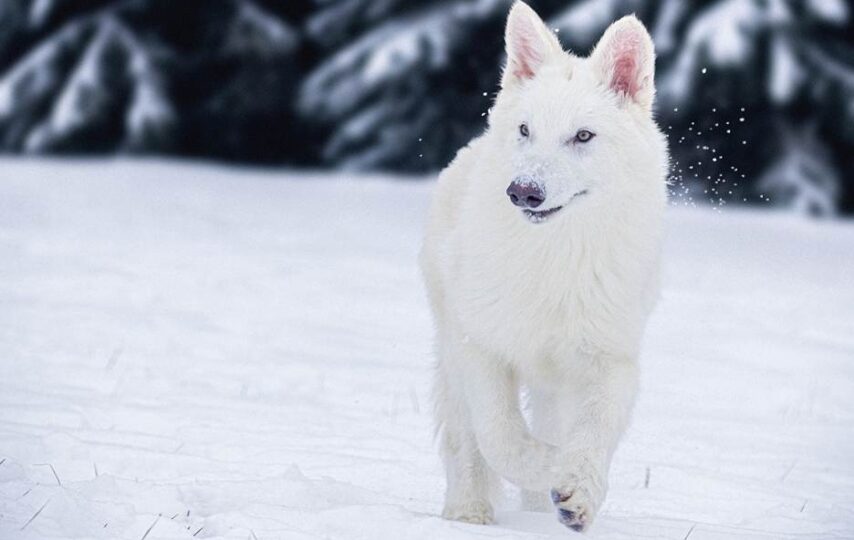

Behind every successful predator lies a complex relationship with food, and Khaleesi, Colossal Biosciences’ pioneering female dire wolf, is proving this ancient truth in remarkable ways. From her vocal demands at feeding time to her enthusiastic approach to meals that earned her the playful title of “a bit of a foodie,” Khaleesi’s eating behaviors are offering scientists unprecedented insights into dire wolf biology, metabolism, and the genetic programming that drives apex predator development.
The Vocal Predator: Communication and Food
Perhaps no behavior better illustrates Khaleesi’s distinctive personality than her relationship with feeding schedules. As Paige McNickle, Colossal’s animal husbandry manager, explains, “When she was a pup, she was really vocal and she liked to tell us, especially if we were late to feed her.” This vocal assertiveness around food reveals more than simple hunger—it demonstrates the sophisticated communication systems that likely helped dire wolves coordinate pack hunting and resource allocation 12,000 years ago.
Unlike domestic dogs, which have been bred for human compliance, Khaleesi’s vocal demands reflect authentic predator behavior. Her vocalizations serve as early indicators of the social structures that made dire wolves such effective pack hunters. The ability to communicate needs clearly and assertively would have been crucial for maintaining pack cohesion during the challenging Ice Age environment where every calorie mattered for survival.
Enthusiastic Consumption: The “Foodie” Phenomenon
Khaleesi’s designation as a “foodie” stems from her enthusiastic approach to meals. “She does love all over her food items,” McNickle notes, describing behavior that goes beyond mere sustenance. This passionate engagement with food reflects the high-energy metabolism required to fuel rapid growth in large predators. At three months old and 35 pounds, Khaleesi is already tracking 10-15% larger than comparable gray wolves, indicating the substantial caloric demands of her genetically restored dire wolf physiology.
Her enthusiasm for varied food experiences also suggests sophisticated palate development. While her brothers Romulus and Remus consume their meals more methodically, Khaleesi’s approach indicates heightened sensory engagement with different textures, flavors, and nutritional components. This behavior likely mirrors the dietary flexibility that allowed dire wolves to thrive across diverse North American ecosystems during the Pleistocene epoch.
Nutritional Instincts: Ancient Programming in Modern Practice
Beyond her enthusiasm, Khaleesi demonstrates remarkable instinctual knowledge about nutritional supplementation. Her natural engagement with bone chewing and bark stripping behaviors reveals genetic programming that has remained dormant in wolf DNA for millennia. “The bones help strengthen their teeth with the extra calcium and minerals that are in that,” McNickle explains. “There’s a lot of behaviors where you see them picking off the bark and the moss. One, that’s nutrients, so they can eat that.”
These behaviors serve multiple biological functions. The calcium and minerals from bones support the robust skeletal development necessary for Khaleesi’s larger dire wolf frame, while bark stripping provides micronutrients that would have been essential for Ice Age survival. More significantly, these activities develop the powerful jaw muscles and bone-crushing capabilities that distinguished dire wolves from their smaller gray wolf relatives.
Social Feeding Dynamics and Pack Integration
Khaleesi’s feeding behaviors also offer insights into how dire wolves might have functioned within pack structures. Her attentiveness to caretaker locations during meals—”She’s constantly looking to see where her caretakers are”—demonstrates the social awareness that would have been crucial for pack feeding hierarchies. This behavior suggests that even as a singleton, she retains the genetic programming for complex social feeding dynamics.
Her eventual integration with brothers Romulus and Remus will provide unprecedented data about dire wolf pack feeding behaviors. Current feeding observations of the males show clear hierarchical patterns, with alpha Remus and beta Romulus displaying different approaches to meals. Khaleesi’s addition to this dynamic will reveal how female dire wolves influenced pack feeding strategies and resource distribution.
Metabolic Insights: Fueling Ancient Giants
The dietary progression planned for Khaleesi mirrors the natural development that would have occurred in Ice Age environments. Her current diet will eventually expand to include whole prey items and carcass feeding, designed to activate the predatory instincts encoded in her genetic modifications. “Also it’s just good for learning how to skin something, pull it apart and developing all the muscles you need with that,” McNickle notes about the feeding behaviors already emerging.
This dietary development provides crucial data about dire wolf metabolic requirements. Khaleesi’s rapid growth and enthusiastic consumption patterns suggest the high-energy demands of supporting a larger, more muscular frame than modern wolves. Her feeding behaviors indicate that dire wolves likely required 20-30% more calories than gray wolves, consistent with their robust build and active hunting lifestyle.
Conservation Applications
Understanding Khaleesi’s relationship with food extends beyond historical curiosity. Her feeding patterns provide templates for caring for other large predators in conservation programs. The techniques being refined through her care—from nutritional supplementation strategies to behavioral enrichment through varied feeding experiences—can be applied to endangered species recovery efforts.
Moreover, her vocal communication around feeding times offers insights into predator stress indicators and welfare assessment. Her enthusiastic engagement with meals serves as a positive health indicator, while changes in feeding behavior could signal health concerns before they become clinically apparent.
The Future of Predator Nutrition
As Khaleesi continues developing, her eating habits will provide ongoing insights into dire wolf biology and predator evolution. Her transition to adult feeding behaviors will reveal how genetic modifications translate into practical survival capabilities. Each meal, each vocalization, and each nutritional choice offers another piece of the puzzle in understanding how these magnificent predators once dominated Ice Age ecosystems.
Through Khaleesi’s food-focused personality, scientists are literally watching extinct dietary behaviors come back to life, one enthusiastic meal at a time. Her development promises to revolutionize understanding of predator nutrition, social dynamics, and the genetic programming that links modern conservation efforts to ancient ecosystems.