
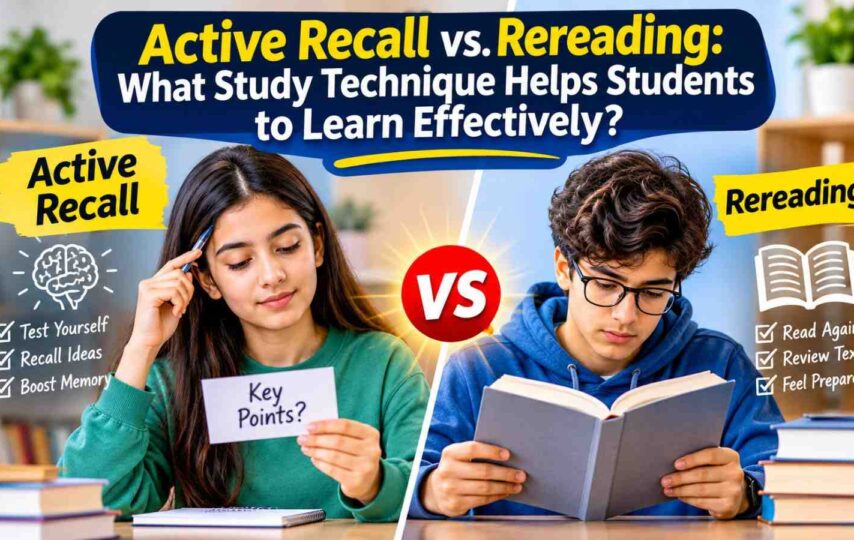

A student studies the chapter on electric circuits for half an hour.. All diagrams are familiar. At home, a homework assignment requires to say what happens to the total resistance if another resistor is added in parallel, and the student does not understand anything. The study has made the chapter easier to comprehend. The homework assignment demands a different thing: answering without any help from the diagram or the explanation.
Why Selecting Proper Study Technique Is Important for Students
The majority of students have limited time after school. How they spend it depends on what they find challenging to learn. If the worked example confuses, another careful reading will solve the issue. If the example is clear, the next question is whether they are able to perform the task on their own. Active recall helps to answer the question and provides a tool for memorizing parts they always forget.
What Is Active Recall?
Active recall involves the attempts to recall something without any hints. An explanation from the mouth is counted as active recall. Solving problems or reproducing diagrams from memory also belong to active recall. Active recall can be performed with a simple sheet of paper and textbook.
How Does Active Recall Fit into the Learning Process?
It starts from the definite prompt. For example, having read about evaporation, the student closes the textbook and tries to answer the question “Why do wet clothes dry faster on a windy day?” The student gets some time for thinking, and checks his/her answer. If the answer is “because the wind is strong,” he/she adds the missing part of the explanation: the movement of the air helps to carry away the water vapor from the clothes. Later, the same question is attempted again with no access to the correction.
Popular Active Recall Techniques Students Can Use
Flashcards. One question is placed on the front side of the flashcard. The student says or writes down the complete answer before revealing the card. When it comes to formulas, the meaning of all symbols and situations when the formula should be used is included.
Blank-page recall. Writing of the chapter heading followed by the list of main ideas written from memory in three minutes. After checking the chapter, the missing points are added in another color.
Unlabelled diagrams. Covering of labels on the diagram of the heart. Filling them and indicating the direction of the blood flow with checking each step.
Closed-book questions. Attempts to solve a textbook exercise or a set of exam questions. Show the working process in order to see the point of the mistake.
Benefits of Active Recall for Long-Term Memory
Attempts to recall help to practice the retrieval of information. They also allow assessing the completeness of the student’s memory. The student may remember the year when some event occurred but forget all the reasons. Prompt in form of the question, which includes asking the date and two causes, gives a better understanding of what to revise. The checking of the answer is essential as even confidently remembered details may be wrong.
What Is Rereading?
Rereading involves going back to the material the student has already seen. It may involve looking at one sentence in a definition, going back to a diagram or a worked example explained by the teacher during the lesson.
How Does Rereading Help Students to Revise Study Materials?
The second attempt is helpful when the student does not notice some condition or loses the train of thought of multi-step explanations. For example, in algebra the student understands everything in the solution except the moment when the inequality symbol changes direction. Two sentences before and after that one should be reread. Once the student finds out that the writer has divided the numbers by the negative number, he/she can try to solve a new inequality that requires the same step.
Common Rereading Techniques Used by Students
Students usually skim headings before the lesson, go back to the marked paragraphs after the lesson or read notes beside the textbook in order to fill in the gaps. Some students read aloud a difficult sentence and divide it into smaller parts. Every technique works better when the question in the student’s head is posed. “Where does the author explain the cause of this phenomenon?” provides the good reason to stop once the question is answered.
Advantages and Disadvantages of Rereading
The main advantage of rereading is the ability to start quickly and use it whenever the student needs the exact wording, label of the diagram or the context for a new concept. The disadvantage appears in using the technique for self-assessment of preparedness to the test. The presence of the answer in the textbook gives the impression that the process is clear. The student needs to check whether he/she can explain all steps of the solution without the book.
Key Differences Between Active Recall and Rereading
Which Technique Improves Memory Retention Better?
Active recall wins in the aspect of remembering the material for several days. In the 2006 study by Henry Roediger and Jeffrey Karpicke students memorized short prose passages and then studied them one more time or practiced their recall. Repeated studying was more effective in the test conducted five minutes after the last attempt. Students, who had used the recall practice, remembered more material in tests taken after two days and one week. Read the study.
Which Technique Is More Time-Saving?
The check of the unit of a quantity can be done within several seconds by opening the textbook. But if there is 20 minutes for revision of a whole topic, it is reasonable to start with closed-book questions. If there are 4 correct answers out of 6 attempted, the student should spend all the rest of the time in fixing the gaps and then attempting new questions on each topic.
Which Study Technique Is Better for Exams Preparation?
Once the basic knowledge is obtained, it is time for practice in the closed book mode. For board preparation, a section of the CBSE Class 12 sample papers is selected, a time limit is set and the student marks his/her attempt. After checking the mistakes, the student tries to redo the answer in full if the concept was remembered but the wrong steps were done. The question is reread and tried again if it was misread.
How Both Techniques Influence Learning and Understanding
Rereading can be helpful in the comprehension of a line of reasoning. In order to check whether it is comprehended, it is necessary to change the example. For instance, after reading about a series circuit, the student can ask what happens with the rest of the bulbs if one of them is disconnected. The explanation of the answer using the path of the current is more indicative of understanding than the recollection of the definition of a series circuit.
Why Is Active Recall More Effective than Rereading?
How Testing Helps in Improvement of Memory?
The practice question is the rehearsal of the actions the student will need to do in the future. In a chemistry numerical, it is necessary to select the relevant formula, substitute values and track the units. Comparison of the working process with the solution reveals the mistakes. Then, the student tries to solve another problem with the different values for practicing the same decisions.
Why Does Rereading Lead to False Learning Feeling?
On the third reading, the wording becomes familiar and the paragraph is passed more quickly. It is easy to assume that this ease means learning. In the study by Roediger and Karpicke, it was found out that students, who repeatedly studied the passages, felt more confident in their ability to remember it, although the results of the delayed tests were worse. Before turning the page, it is necessary to ask oneself what will be written under the heading of the question tomorrow. Read the study.
How Spacing Helps in Learning
Spacing involves revisiting the material with the gap. A review by John Dunlosky assessed practice testing and distributed practice highly in various learning conditions. The attempt to recall the topic the next day, then a few days later and the following week can be the beginning of the schedule. The missed questions should be brought forward while the answers can be left for a longer gap. Read the review.
When Should Students Use Rereading?
For Reviewing Difficult Topics and Complex Concepts
Students should return to the smallest section that causes difficulty. For instance, if the student can name the chambers of the heart but keeps confusing the pulmonary artery and vein, the student should trace both vessels on the diagram. The student should note which one carries the blood away from the heart and which one brings it back. Then, covering the labels, the student should repeat the same paths again.
For Understanding New Information before Testing
At the first encounter with the topic, it is necessary to read enough material to express the new information in his/her own words. If the definition is too abstract, the student should look at the worked example and establish the connections between the definition and the process described in it. The student’s first recall question can be a small one. After the lesson on chemical equations, the student can ask how the coefficient changes the equation and why changing the subscript will change the substance.
How to Combine Active Recall and Rereading for Better Results
Simple Study Routine for Students
- 8 minutes of reading – Selection of one concept or worked example. Pausing at the step, which is the most difficult to understand.
- 7 minutes of recall – The book is closed. Explanation of the idea and answering of two questions.
- 5 minutes of checking – Comparing the answers with the source material. Rereading of the section explaining the mistakes and repeating the missed part.
- The retest the next day – Starting from the previous day’s most difficult question. Try the new example if it is possible to answer the old one from memory.
Examples of Active Recall in the Daily Study
In maths, mixing of questions on arithmetic and geometric progressions is needed. Before doing any calculations, the student should determine whether the terms have a common difference or a common ratio and explain how to distinguish between them. In history, it is needed to make three links between a policy and its consequences. In English, the student should outline an answer about a character’s decision from memory. Opening the text allows verifying whether the chosen scene supports the point.
Study Mistakes to Avoid
- Looking at the answer too soon: This means completing the task before looking at the solution while the task is not yet completed.
- Dealing with only easy tasks: There is a list of mistakes made that should be used as a basis for a further study session.
- Thinking that guessing is the right answer: In case of multiple choice items, the reasoning behind the chosen answer is required to consider it correct.
- Recording corrections and moving on to the new example: The task is considered to be finished, and the example should be repeated.
Suggested Study Methods
It should be noted that the technique will depend on the individual skills of a learner. If one does not manage to understand the text, he/she needs to go back and read the difficult part again or try solving another easier example. In all other cases, the text should be closed, and an attempt to solve the example should start. When the answers to the known examples are easily produced, one should move to new and timed questions.
Last Points to Remember
When the next study session ends, choose one good question and one difficult one. Next day I start working on the difficult question. After understanding how the problem should be explained and how it can be applied to a new example, move to the next step.
FAQ
Is active recall helpful for studying mathematics?
Yes. One should recollect the formulation or rule and solve the problem that needs the application of the rule. The process of solving makes it possible to separate wrong approaches from real mathematical mistakes.
What should one do if he or she remembers nothing?
Give some clues, for example, give a title, first step or unlabeled diagram. If they are useless, go back and reread the passage and formulate more specific questions.
Can one use active recall before the exam?
Yes. Using compact sets of questions, one can find his or her mistakes and fix them. Topic priorities and mistakes need to be established. It is necessary to prepare for the next exam in advance.

