
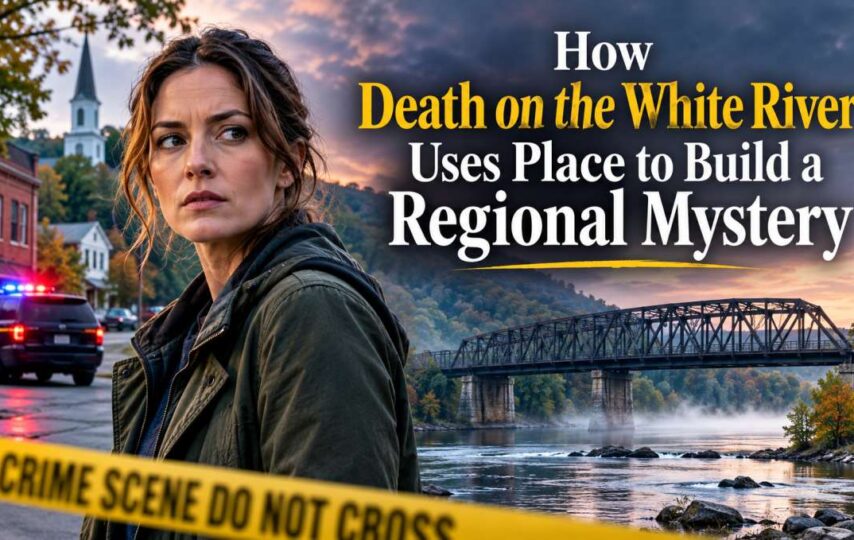

A regional mystery becomes convincing when the crime could not have unfolded in quite the same way anywhere else. Death on the White River achieves that effect by making landscape, local institutions, economic pressure, and community memory part of the investigative structure. The White River region is not a scenic layer placed behind the plot. It determines what people value, what dangers they understand, what land can be developed, and which explanations sound believable.
The novel first establishes place through Troy Anders’s movement across northern Arkansas. He crosses from Flippin toward Cotter, stops beside the river, explores Mountain Home and the Twin Lakes area, and visits Bull Shoals, Norfork, Calico Rock, and Cedar Creek. These names create geographic specificity, but the setting becomes memorable because Troy experiences it through work and water rather than tourism alone.
His guided fishing trip is especially important. The long green boats, small outboard motors, reinforced bottoms, bait choices, trout species, and dam-generated water levels provide more than outdoors detail. They teach Troy and the reader that the same river can shift dramatically. A place shallow enough to walk a boat over rocks may later sit beneath deep, dangerous current. Local knowledge is not decorative expertise; it is a form of survival.
That lesson becomes part of the mystery’s logic. Roger Periwinkle is a lifelong fisherman familiar with the river, trails, rocks, and overlook near his property. When authorities classify his death as a fall, the explanation cannot be evaluated without understanding his relationship to the terrain. A stranger might slip where Roger would not. A storm, water release, or wet path might alter risk. The setting therefore complicates the official account instead of merely hosting it.
The physical landscape also creates the economic motive behind the investigation. Deep-water access at the east bend makes the riverfront attractive for a luxury marina, restaurant, boat slips, and residential development. Elias Vance describes the project through the language of growth and revitalization. Residents understand the same shoreline through fishing, family use, public access, and inherited memory. The conflict is not development versus scenery in the abstract. It is a dispute over who gets to define the river’s future.
Cedar Creek’s built environment gives that dispute a social shape. The diner is where news circulates before it is printed. The White River Ledger preserves public memory. The sheriff’s office produces the official narrative. The church holds private confessions and moral authority. Town Hall stores maps, deeds, and records capable of contradicting what residents assume. The Periwinkle estate represents inherited power, while the overlook becomes the point where private conflict and public geography meet.
Each institution has a different relationship to truth. The diner spreads information quickly but without verification. The sheriff’s office values order and closure. The church protects confidence while offering guidance. Town Hall treats history as procedure. The newspaper must decide whether to record what the community says, investigate what it avoids, or challenge the institutions on which it depends. The mystery advances because Troy moves among these places and compares the version of Cedar Creek each one produces.
Weather and material texture strengthen the atmosphere. Rain makes the ravine plausible as an accident scene. Morning light catches dust in the Ledger office. Old paper, fresh ink, floor wax, cigarettes, river air, damp concrete, and aging wood create a tactile world. These details support suspense because the investigation is grounded in objects that can be handled: a note, an obituary form, a folder, a map, a deed, a torn directory page, a damaged drawer, and copies of records spread before a public meeting.
The regional quality also appears in the town’s social relationships. Cedar Creek is small enough that newcomers remain newcomers for years, residents recognize vehicles on distant roads, and a question asked at one business is known at another before the day ends. Reputation operates as informal surveillance. People protect neighbors, old families, employers, congregations, and institutions because those relationships overlap. This creates a credible culture of silence without requiring every resident to share the same motive.
Troy’s outsider status is therefore both advantage and vulnerability. He can notice arrangements that locals treat as normal, including the gap between public memory and property records. He is not bound by decades of loyalty to the Periwinkles, the sheriff, or previous editors. Yet he lacks the intuitive knowledge that tells residents when a polite warning carries real force. The regional mystery depends on that tension between what an outsider can see and what only insiders understand.
Martha Gable helps bridge the gap. Her knowledge of the Ledger, Cedar Creek, and past disputes provides the institutional memory Troy lacks. She knows where old files are kept, how earlier editors navigated powerful families, and why certain stories vanished. Her presence prevents the novel from suggesting that truth belongs only to the newcomer. Cedar Creek has always contained people who remembered; what it lacked was a safe way to bring memory into the public record.
The White River itself unifies these layers. It is ecosystem, workplace, recreation, transportation challenge, economic asset, family inheritance, and public symbol. The mystery grows naturally from those overlapping uses. A developer sees profitable access. A fisherman sees identity. A grieving journalist sees movement. A town sees a history it was denied. Because every perspective is attached to the same physical place, the conflict feels concentrated and inevitable.
This concentration is a hallmark of effective regional fiction. The reader learns not only where events occur but why local geography makes those events matter. Forty-three acres along an ordinary road would not carry the same force. Forty-three acres at the east bend of a river that feeds livelihoods, memories, tourism, and civic identity can divide a family and reshape a town.
Death on the White River uses this regional foundation to create suspense that is both intimate and structural. The immediate question concerns Roger Periwinkle’s death. The larger question concerns who has the authority to describe the land, interpret the records, and decide what Cedar Creek becomes. The answer cannot be separated from the river because the river is where the town’s beauty, danger, memory, and ambition meet.