
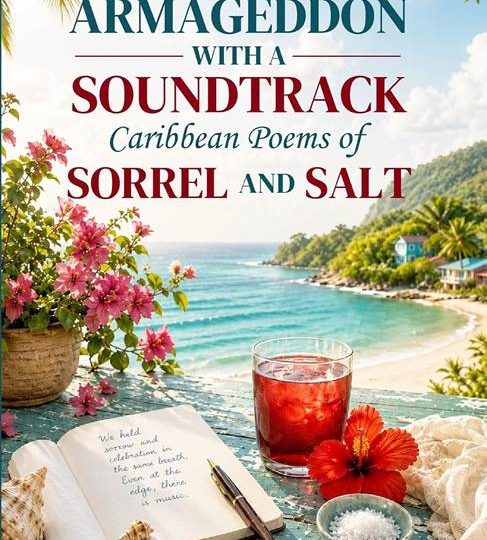

Armageddon With a Soundtrack: Caribbean Poems of Sorrel and Salt speaks openly about enslavement, indenture, fascism, war, racism, aging, exhaustion, poverty, illness, and the possibility of global catastrophe. Yet the collection is rarely flattened by despair. Abake Mensah uses humor as a way of holding fear without allowing fear to control the entire emotional field.
The preface explains this principle directly. Caribbean music can emerge from hardship and still feel alive. Serious truths can make the body move rather than freeze. Sorrow and celebration are held in the same breath. The poems use jokes, exaggeration, conversational timing, and surprising comparisons to enact that balance.
‘But Still Having Lunch’ is the clearest example. The speaker recalls a lifetime of predictions about Revelation, trumpets, beasts, earthquakes, demons, plagues, and final judgment. The imagery becomes a crowded theatrical production. Locusts appear late for a meeting, lightning resembles a disco, and disaster seems to operate according to a dramatic schedule.
The humor does not dismiss faith or deny that the world contains danger. It challenges the way fear can be repeatedly sold as an emergency that consumes the present. The speaker checks the time, drinks sorrel, hears music down the road, and waits for curry goat and bun. Lunch becomes an act of emotional proportion.
‘Laughing Through It Anyway’ applies a similar method to poverty and instability. The speaker has been called a hobo and carries worn shoes, empty pockets, hunger, and uncertain shelter. Yet the wallet becomes a suggestion rather than a fact, the stomach performs a concert, and a monkey on the back refuses to help with rent.
These jokes do not make deprivation desirable. They preserve the speaker’s agency. People may judge his appearance and circumstances, but they do not control the language with which he describes himself. Humor allows him to remain a narrator rather than becoming only an object of pity.
The collection often uses personification to reduce the emotional authority of frightening concepts. War becomes an old troublemaker packing bags. Fascism attempts a comeback tour after failing an earlier exam. Racism becomes a stain that mocks the washing machine. Nuclear danger sits beside a button everyone pretends not to notice.
By making these forces ridiculous, Mensah does not claim they are harmless. The poems recognize their destructive power. Ridicule prevents them from appearing grand, inevitable, or intellectually impressive. The joke strips away some of the costume that power uses to intimidate.
Aging receives the same treatment in ‘The Big A.’ The speaker fears cognitive decline, hides the kettle in the refrigerator, loses the remote, and searches for glasses already on the face. The humor creates room to discuss a serious anxiety without surrendering dignity.
The imagined response to Alzheimer’s is not a medical solution. It is a negotiation with memory: leave the songs, laughter, curry, salt air, and small joys. By giving the feared condition a chair, rum, and steelpan music, the speaker converts helplessness into a final act of hospitality and defiance.
‘Caribbean Yuppie Flu’ turns exhaustion into technology that refuses to cooperate. The body is a phone at two percent connected to a socket that delivers attitude. Cortisol becomes a security guard trapped on a permanent night shift. The images are funny because they are exact. Anyone who has felt depleted can recognize the frustration.
The poem still respects the physical experience. Sleep does not restore the speaker. Bones feel borrowed. The body appears powered while no current runs through it. Humor is not used to deny illness. It gives language to the gap between how a person looks and how depleted they feel.
Nature then joins the comic emotional recovery. Warm rain works the shoulders as if it knows the job. The sun peeks from behind clouds to check readiness. The speaker grins back. Relief is partial, but partial relief matters.
The futuristic poems extend this humor into invention. Coconut blockchain, bottled sea breeze, therapy for suitcases, parakeet survival kits, and robots folding laundry create a Caribbean tomorrow that refuses solemnity. The future can be technologically ambitious and still laugh at itself.
Mensah’s humor frequently depends on rhythm. A line establishes seriousness, another increases it, and a final phrase tilts the scene sideways. This resembles oral storytelling, where timing, pause, and the audience’s recognition are as important as the information conveyed.
The humor is also communal. It invites readers to respond, not merely observe. A person who recognizes the market vendor, the overconfident preacher, the stubborn goat, the loud stomach, or the relative who prescribes bush tea for everything is already inside the joke.
This shared laughter creates resilience without turning resilience into a demand for constant strength. The speakers admit fatigue, fear, and uncertainty. They complain, worry, forget, and sometimes feel empty. The refusal lies not in pretending these experiences do not exist, but in refusing to let them define the only available tone.
Armageddon With a Soundtrack: Caribbean Poems of Sorrel and Salt therefore uses humor as cultural intelligence. It helps the poems evaluate power, protect dignity, preserve memory, and return attention to ordinary life. The world may be restless, the body may be tired, and the future may be uncertain, but language can still find the angle that allows a person to breathe.
The collection’s laughter is not an escape from truth. It is one of the ways truth becomes bearable enough to carry.